Dealer Commerce Platform
Redesigned the product data model for a premium automotive aftermarket retailer — variants, bundles, and relationship logic across PIM, storefront, and ERP — without breaking a live commerce platform.
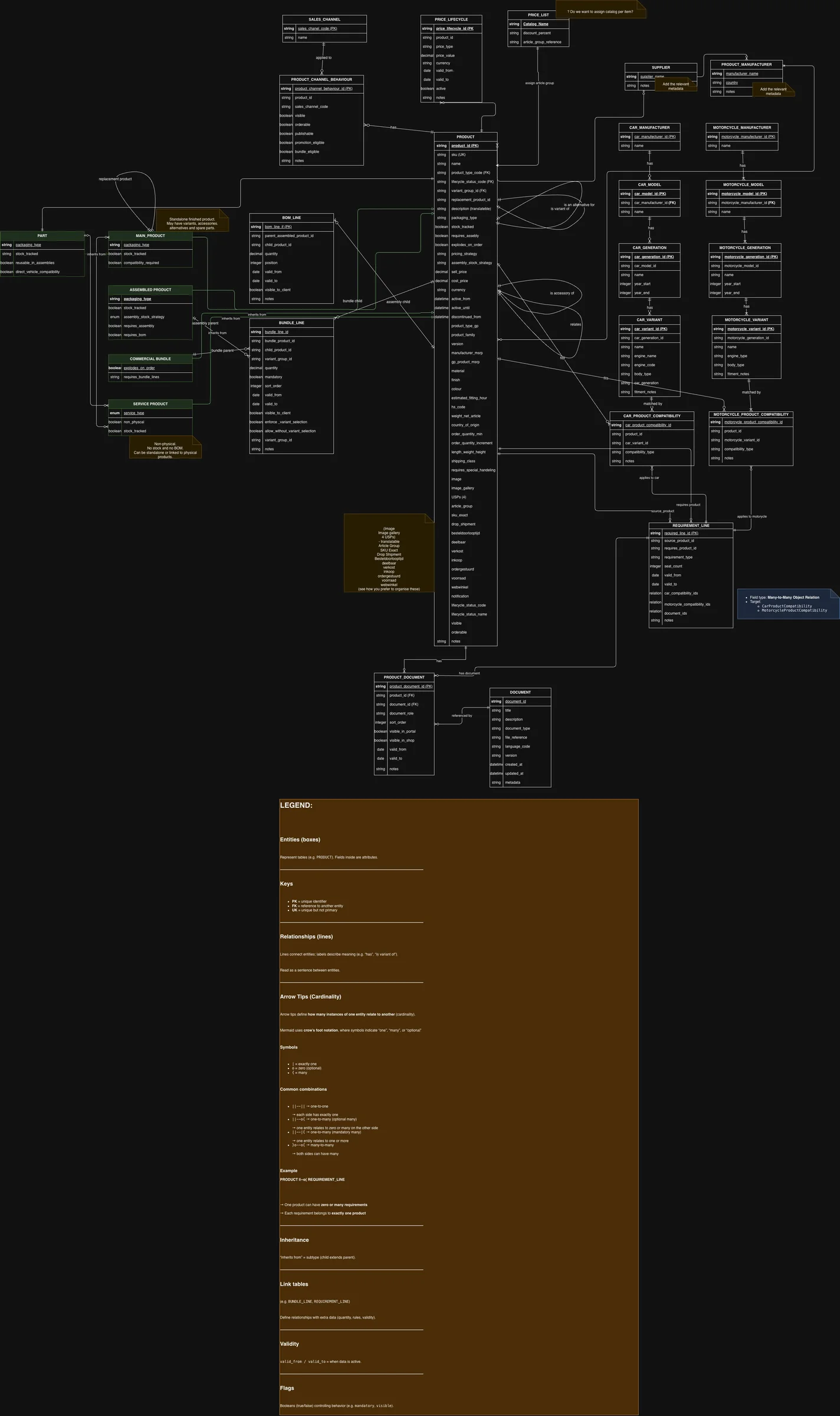
A premium automotive customization and parts retailer runs its business on four connected systems: a PIM (source of truth for product data) feeding a commerce storefront, which in turn feeds ERP and warehouse (WMS) systems downstream. As their catalog of high-end aftermarket parts, bundles, and vehicle-compatibility relationships grew more complex, the existing product data model couldn’t reliably support it — creating data-consistency risk and a ceiling on what the business could actually sell, such as multi-part bundles.
Redesign the core product data model to cleanly support variants, bundles, and relationship-based logic (spare-part-for, accessory-for, alternative-for, mandatory/requires) — consistently across all connected systems — without breaking a live, revenue-generating platform.
- Led ERD modeling of the new product data structure jointly with the Lead Developer
- Worked directly with the client’s Product Owner to align the new model with real business and catalog needs
- Authored the implementation plan and migration plan for moving from the existing structure to the new one live
- Led a team of 5 (Lead Developer, 2 frontend engineers, 2 backend engineers) through delivery
- Mapped cross-system impact — changes to the product model ripple from the PIM into storefront behavior and downstream ERP/WMS integrations
- Led the implementation and a zero-rollback live migration across four systems (PIM, e-commerce, ERP, WMS) through to completion over a 10-week redesign
- Checkout conversion lifted from 50.9% to 73.2% (p < 0.001) — a sustained +5–7pp gain above the underlying trend
- Items per order grew 46%, from 3.45 to 5.03, by resolving catalog-compatibility errors
- Return rate cut 24%, from 8.2% to 6.2%
- Bundles shipped as a new sellable product type — previously impossible under the old schema
- Isolated true causal impact with trend-adjusted counterfactual modeling — deliberately setting aside unadjusted channel-volume growth (+50%) and outlier-skewed mean AOV (+16%) as not causally reliable